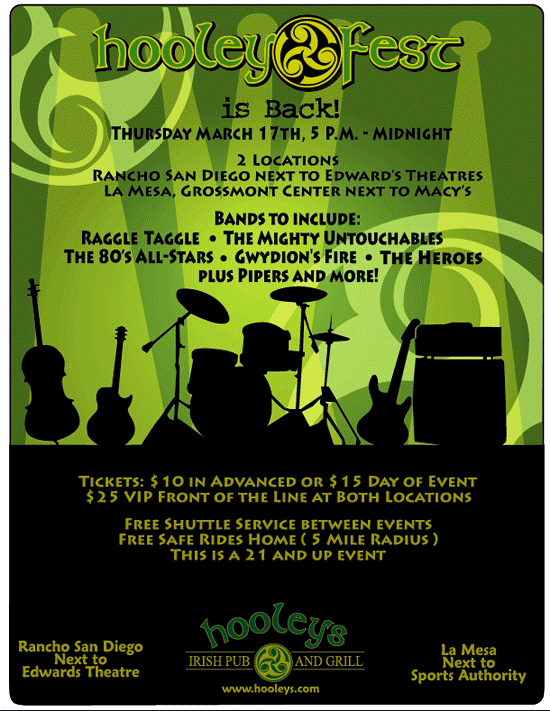
Event began 12 years ago in Rancho San Diego and added second venue in 2010. Majority owner started St. Pat’s party as fundraiser in tribute to his late brother Scott. In its second year at Grossmont Center, the St. Patrick’s Day music-and-beer blowout called Hooley Fest attracted every kind of green shirt, hat, eye wear and accessory—and 1,500 paying customers in a fenced parking lot.
Wearing a brown T-shirt and dark HooleyFest jacket was a beaming Craig MacDonald, soaking up the relaxed but high-energy atmosphere. McDonald belonged as much as anyone. He owns the joint. The majority owner and managing partner of Hooley’s Irish Pub and Grill, MacDonald—who is Irish—oversaw the event here as well as at a Rancho San Diego location, where HooleyFest debuted 12 years ago. The first HooleyFest had a somber genesis—as a fundraiser for a YMCA ball field in tribute to Craig’s brother Scott, who died of brain cancer in 1983 at age 24. Scott had coached girls softball. After eight years of HooleyFest's in Rancho San Diego, enough money was raised to build the Scott MacDonald Memorial Ballpark at the McGrath Family YMCA, MacDonald said. Meanwhile, the St. Patrick’s Day celebration of beer and Irish music had taken on a life of its own—adding Sycuan as a sponsor and growing to 5,000 attendees, and out of hand.
MacDonald, 48, said he scaled back the event in recent years, making it “more manageable.”He holds the holiday music fest, he said, because the “public demands it.” “We’re really glad when it’s over—really,” he said Thursday night. A resident of Mount Helix, MacDonald got help from his 100 employees—50 at each location. Jim MacDonald, his 79-year-old father, also pitched in, he said. Much beer was poured (and other mixed drinks), and traditional fare served as $12 dinners. But ask MacDonald his favorite brew, and his instant answer: Guinness Draft. He’s especially proud of his bar being a “certified Guinness pub”—meaning his pouring equipment meets specifications and chemistry standards.
Co-owner Scott Schwartz (along with Mark Manning) wore a Hawaiian shirt with a hint of green Thursday night and said: “Everything I get [in feedback] is just positive. People love it. It’s nice to have an event when the community can get together in a large format.” MacDonald said 1,500 square feet of the southern Grossmont Center parking lot was fenced off for HooleyFest, and remarked that the mall “loves the event.” So does SureRide Inc.—a San Diego minibus service that MacDonald hired. Revelers who have too much liquid refreshment get free rides home, he said. Last year, 250 people availed themselves of the “limo-buses” with GPS capability and room for 20 passengers each—being taken either to a nearby trolley station or straight home. The six buses also were used to shuttle St. Paddy’s Day celebrants between the two HooleyFest's. The event began at 5 p.m. and ended at midnight, and then Hooley’s crew went to work. “We have to clean up the entire place and be ready to open at 10 o’clock [Friday morning],” MacDonald said. Should we all go and help clean up the mess we made ?
Sharon and I went last night and I know I had a great time but I'm sure it was the company that I went with that made it such a great time. Let all the Hooligans party and to think its only Friday.
Shelter Island was first recorded on a United States coast and geodetic map as a “mudbank”. It was gradually formed by deposit of soil and sand from the San Diego River. The sandbar was used to dump materials from dredging of San Diego Bay for US Navy requirements in World War II which required a deepening of the harbor channel, further building it up. In the late 1940’s The San Diego Harbor Commission undertook a dredging program that provided a new entrance to the yacht basin, and the dredged material was used to connect Shelter Island with Point Loma, and to further raise the island 14 feet above low tide; then another project raised it 7 feet above high tide. In 1960, the media described Shelter Island as “something from nothing”, “a testimonial to human ingenuity”, and “a man made wonderland of sub-tropical splendor.
On October 25, 1934, the Federal Government and the San Diego Harbor Commission initiated dredging of San Diego Bay which also provided a channel 200 feet wide and 20 feet deep from the main harbor to the San Diego Yacht Club clubhouse. The dredged material was pumped out and deposited in such a way that it was possible to place the clubhouse on dry land. A sand spit was built up in front of the clubhouse dividing the main channel and the yacht anchorage, forming what is now called Shelter Island. Before the spit was built up, the area known as Shelter Island could be seen only at low tide.
In 1950, the San Diego Harbor Commission, the agency that would grow to become today’s Port of San Diego, began a dredging program to widen and deepen the entrance channel for San Diego Bay. The sand taken from the bottom of the bay was added to a natural sand bar near the Bay’s north shore. What had for centuries served as only an impediment to navigation soon became one of the most spectacular locales for waterfront businesses of every kind. Shelter Island was born. Today the island is the first publicly accessible landfall found upon entering San Diego Bay. It is the central feature in the first of ten planning districts defined in the Port’s Master Plan. And, for those entering the Port from the ocean, the Shelter Island is the subject of a natural picture almost perfectly framed by the United States Naval installations on North Island and Ballast Point. Shelter Island and its surrounding areas act as the primary gateway and public welcome point for the entire Port of San Diego. It is here that the Port’s spectacular waterfront promenade finds its beginnings.
Shelter Island is a neighborhood of Point Loma in San Diego, California. It is actually not an island but is connected to the mainland by a narrow strip of land. It was originally a sandbank in San Diego Bay, visible only at low tide. It was built up into dry land using material dredged from the bay in 1934. It was developed in the 1950s and contains hotels, restaurants, marinas, and public parkland.
Shelter Island is owned and controlled by the Port of San Diego, which also provides all police and other public services. Shelter Island businesses lease their location from the Port. Under California law, property on Shelter Island cannot be sold and permanent residences cannot be built there, because the area falls under the law governing public tidelands.
Shelter Island contains several notable pieces of public art. The Tunaman's Memorial, a larger-than-life bronze sculpture by Franco Vianello, is dedicated to the tuna fishermen who were formerly an important part of the area's economy. The Yokohama Friendship Bell, a large bronze bell housed in a pagoda structure, was a gift from the city of Yokohama in 1958 to commemorate the sister city relationship between San Diego and Yokohama. Pacific Rim Park at the southwestern end of Shelter Island was created by artist James Hubbell and is centered on a round bubbling fountain called Pearl of the Pacific. The fountain is surrounded by a mosaic wall and a dramatic arch and is a popular place for outdoor weddings.
Shelter Island contains one yacht club, the Silvergate Yacht Club, and it creates a sheltered harbor for two others, the San Diego Yacht Club and the Southwestern Yacht Club. Shelter Island is known as a destination for superyachts because it contains one of the few marinas in San Diego Bay with a deep enough harbor for these oversized vessels. The annual YachtFest, spotlighting superyachts, is held at Shelter Island Marina every September. The event also features mock gunbattles between two replicas of 19th century tall ships from the collection of the San Diego Maritime Museum.
From June through September, nationally known musicians and comedians perform at an outdoor concert venue on Shelter Island. The area is a popular place for viewing the annual Fourth of July fireworks display over the Bay, as well as the Parade of Lights, a December tradition in which boats decorated with holiday lights parade on the Bay to be viewed from the shore.
The "island" is 1.2 miles (1.9 km) long and only a few hundred yards wide. A single street, Shelter Island Drive, runs the length of Shelter Island and also connects it to the mainland via a causeway lined with marine-related businesses.


 MacDonald said 1,500 square feet of the southern Grossmont Center parking lot was fenced off for HooleyFest, and remarked that the mall “loves the event.” So does SureRide Inc.—a San Diego minibus service that MacDonald hired. Revelers who have too much liquid refreshment get free rides home, he said. Last year, 250 people availed themselves of the “limo-buses” with GPS capability and room for 20 passengers each—being taken either to a nearby trolley station or straight home. The six buses also were used to shuttle St. Paddy’s Day celebrants between the two HooleyFest's. The event began at 5 p.m. and ended at midnight, and then Hooley’s crew went to work. “We have to clean up the entire place and be ready to open at 10 o’clock [Friday morning],” MacDonald said. Should we all go and help clean up the mess we made ?


